

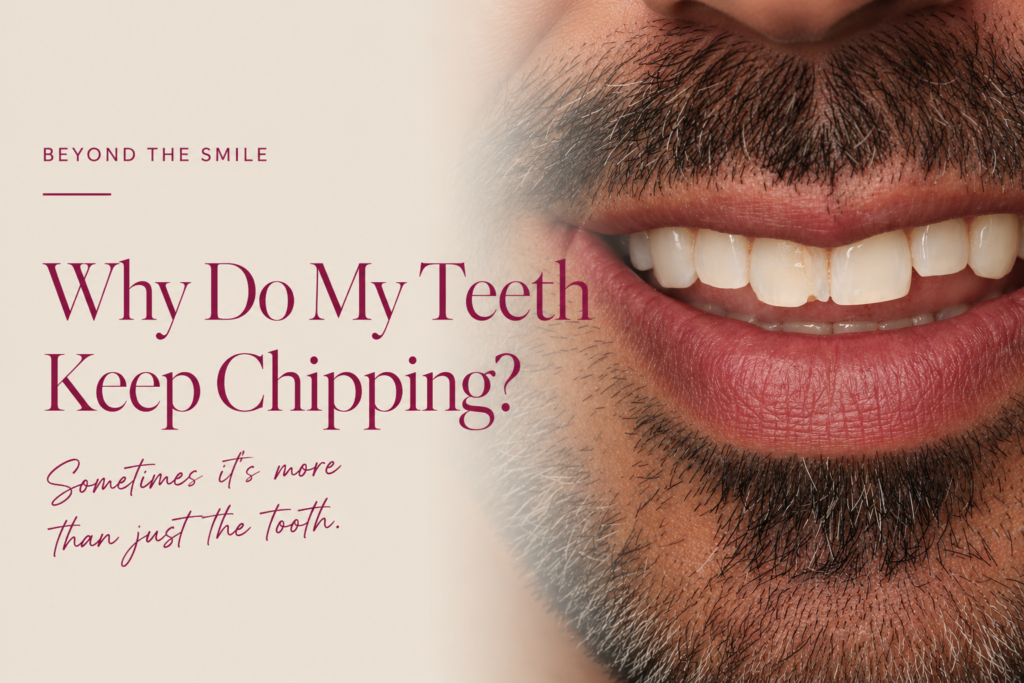
You chip a tooth. It gets repaired. A year or two later, the same thing happens again.
Or perhaps the edges of your front teeth are becoming increasingly uneven, small pieces seem to disappear over time, or fillings that once lasted for years suddenly keep breaking.
It is easy to think you simply have “weak teeth”. But when chipping or cracking happens repeatedly, I start looking a little further.
Why Do Teeth Chip?
There are plenty of straightforward reasons. You might bite unexpectedly on something hard, a tooth may have been weakened by a large filling, or enamel may have become thinner through wear or erosion. And occasionally, accidents simply happen.
But when several teeth are affected or the same tooth keeps breaking, one of the things I want to understand is what forces those teeth are dealing with every day.
Your Bite Matters
Every time you chew, swallow or bring your teeth together, forces are distributed across your teeth.
A deep bite, an uneven bite, missing teeth or certain tooth positions can mean that particular teeth take more pressure than others. Over time, those forces may contribute to wear, small fractures or repeated chipping.
This doesn’t mean that every chipped tooth is caused by the bite. But when a problem keeps returning, the way the teeth meet is something worth considering.
What About Grinding and Clenching?
Grinding and clenching, often referred to as bruxism, can also place considerable forces on the teeth.
Some people know they do it. Others have absolutely no idea until their dentist notices signs such as flattened or shortened teeth, small enamel cracks, chipped edges or restorations that repeatedly fracture. Some people also experience tired jaw muscles or headaches.
Bruxism itself isn’t always straightforward either. Stress may play a role for some people, and grinding can occur while awake or during sleep. There are also recognised associations between sleep bruxism and other sleep-related factors.
That doesn’t mean everyone who grinds has a sleep problem. It simply means that sometimes it is worth asking a few more questions rather than assuming someone is “stressed”.
Why Does My Filling Keep Breaking?
If a filling or piece of composite bonding breaks once, repairing it may be all that is needed.
If the same restoration repeatedly breaks, however, I want to know why. Is the tooth heavily restored? Is there enough healthy tooth structure remaining? Is that tooth receiving excessive force? Or would a different type of restoration be more suitable?
Sometimes another filling is entirely appropriate. In other situations, an onlay or crown may provide better protection for a heavily damaged tooth.
Repairing the Tooth and Protecting the Result
Treatment therefore depends on what we find.
A small chip may simply need smoothing or a conservative composite repair. More significantly damaged teeth may benefit from composite bonding, an onlay or a crown.
For someone who clenches or grinds, a carefully designed night guard may sometimes help protect the teeth and restorations. And where tooth position or the bite is contributing to the problem, orthodontic treatment such as Invisalign may occasionally form part of the longer-term plan.
There isn’t one solution for every chipped tooth, and there shouldn’t be.
When Should You Have a Chipped Tooth Checked?
A tiny chip isn’t necessarily an emergency. However, I would recommend having it assessed if the tooth is painful or sensitive, a larger piece has broken away, it feels sharp, or you notice cracks or repeated breakages.
And if your teeth seem to be chipping more frequently than they used to, mention that too. Sometimes the pattern tells us more than the individual chip.
Looking Beyond the Chip
I enjoy repairing chipped teeth. Getting the shape, texture and colour to disappear naturally into the surrounding tooth is one of those wonderfully detailed parts of dentistry.
But a beautiful repair that repeatedly breaks isn’t a particularly successful one.
So sometimes the most important question isn’t simply “How can we repair this tooth?”
It is “Why did it break in the first place?”
And that is where looking beyond the chip can make all the difference.