

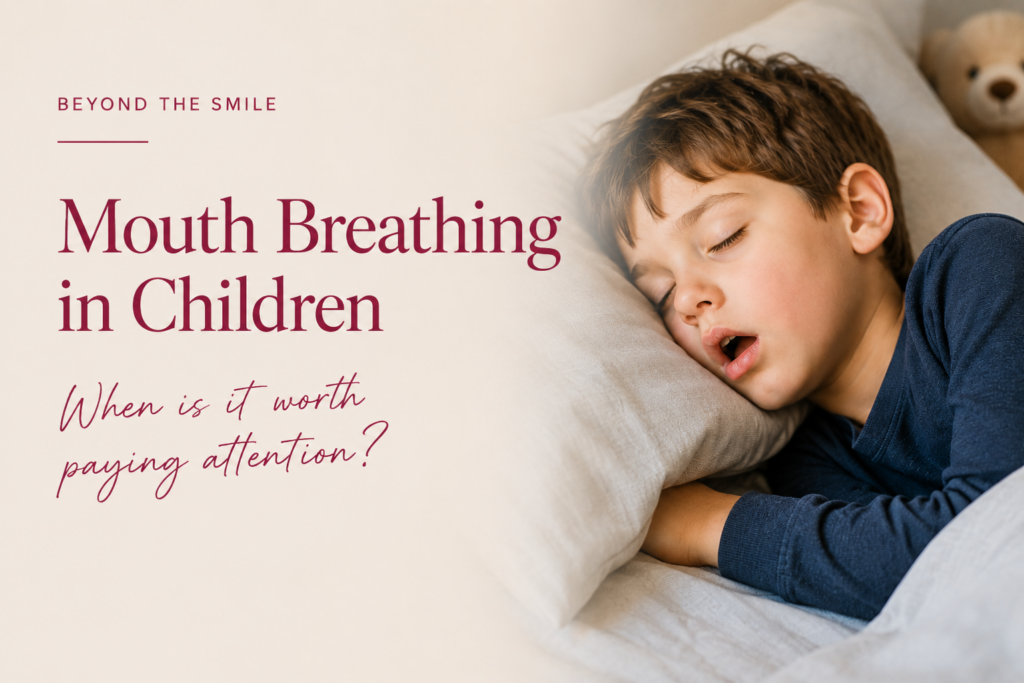
You check on your child before going to bed and notice their mouth is open.
Perhaps they snore occasionally. Maybe they seem to toss and turn all night. Or you have simply started noticing that they breathe through their mouth far more often than you do.
Does it mean something is wrong?
Not necessarily.
Children get colds, noses become blocked and occasional mouth breathing is completely understandable. What interests me more is when mouth breathing becomes the usual pattern rather than the exception, particularly when there are other signs alongside it.
What Should Parents Look Out For?
Mouth breathing rarely tells us very much in isolation. It is the overall pattern that can be more interesting.
Some things worth noticing include:
-
- regularly sleeping with the mouth open
- frequent snoring
- restless or disrupted sleep
- difficulty keeping the lips comfortably together
- waking with a dry mouth
- grinding the teeth at night
- appearing tired despite having had enough hours of sleep
- difficulties with concentration or attention
- persistent bedwetting beyond the age you might expect
- crowded teeth or a narrow-looking dental arch
None of these automatically means that your child has a breathing or sleep problem.
But when several occur together, and particularly when they persist, I think they are worth paying attention to.
What Does Breathing Have to Do With Teeth?
Quite a lot happens while a child’s face and jaws are growing.
The tongue, lips and cheeks are constantly interacting with the developing teeth and jaws. Ideally, when we are not eating or speaking, the lips rest comfortably together and the tongue spends much of its time resting against the palate.
When a child regularly needs to breathe through their mouth, that resting posture may change. The tongue may sit lower and the lips remain apart more frequently.
Research has found associations between persistent mouth breathing and differences in dental and facial development. But this is important: growth is complicated.
Genetics matter. Habits matter. Nasal obstruction, allergies, enlarged tonsils or adenoids and many other factors may also play a role.
So I would never look at crowded teeth or a particular facial shape and conclude that mouth breathing must have caused it.
Instead, it is another piece of the puzzle.
Why the Tongue Matters
The tongue is something I have become increasingly interested in during recent years.
We often think of it simply as something we use to speak and eat, but its resting position and movement are also part of the environment in which the teeth and jaws develop.
That is why, when assessing a child, I am interested not only in whether their teeth are straight.
I also look at how they breathe, where their tongue rests, how they swallow and whether their lips can come together comfortably.
Sometimes everything is functioning beautifully.
Sometimes those observations raise another question.
Why Might a Child Breathe Through Their Mouth?
There isn’t one answer.
Sometimes it has simply become a habit. In other children, nasal breathing may genuinely be difficult because of allergies, persistent congestion, enlarged tonsils or adenoids, or another obstruction.
This distinction matters.
If a child cannot comfortably breathe through their nose, simply telling them to keep their mouth closed isn’t going to solve the problem.
Where I suspect that something may be interfering with nasal breathing or sleep, assessment by the appropriate medical professional may therefore be an important part of the picture.
What Happens at an Assessment?
For me, this isn’t about looking at a child who mouth breathes and immediately recommending treatment.
It starts with observation and questions.
How do they breathe during the day? What happens when they sleep? Do they snore? Where does the tongue rest? How do they swallow? How are the jaws and dental arches developing?
Sometimes reassurance and monitoring are all that is needed.
Sometimes we identify habits that could benefit from support.
And occasionally the findings suggest that further assessment, for example by a GP, ENT specialist or another appropriately trained professional, would be sensible before considering anything dental.
So, When is Mouth Breathing Worth Paying Attention to?
An occasional open mouth during sleep isn’t something I would lose sleep over, particularly when your child has a blocked nose or a cold.
I would pay more attention when mouth breathing is persistent, happens during both the day and night, or appears alongside snoring, restless sleep, difficulty keeping the lips together or other changes you have noticed.
You don’t need to diagnose the reason yourself.
Simply noticing the pattern is enough.
One of the reasons I have become so interested in this area of dentistry is that children are still growing. Sometimes recognising something early gives us an opportunity to investigate why it is happening rather than waiting until we are dealing only with the consequences later.
And sometimes, after looking more closely, everything is absolutely fine.
Both are useful things to know.