

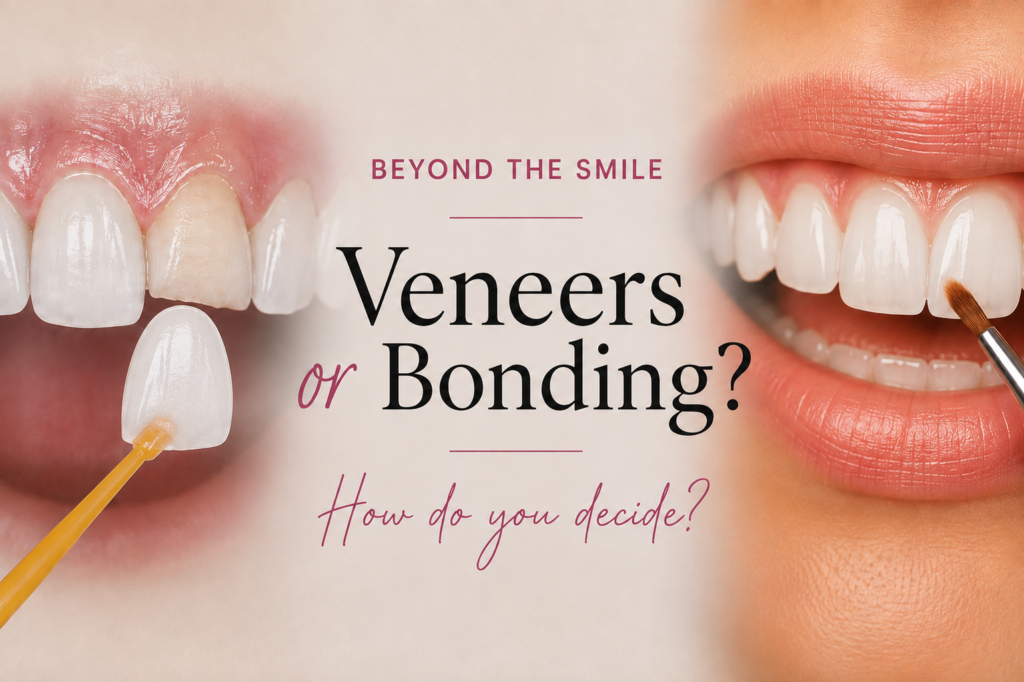
Composite bonding or porcelain veneers?
It is one of the questions I am asked most often by patients considering a change to their smile.
Both treatments can improve the shape, colour and proportions of teeth. Both can close gaps, restore chipped or worn edges and create a more balanced smile.
When comparing composite bonding vs veneers, there is not one option that is automatically better.
The more useful question is:
Which one makes the most sense for your teeth?
Composite Bonding
Composite bonding uses tooth coloured resin which is carefully applied, shaped and polished directly onto the tooth.
One of its biggest advantages is how conservative it can be. In suitable cases, we can make a noticeable difference while removing very little, and sometimes none, of the healthy tooth underneath.
It can work beautifully for small gaps, chipped or uneven edges, black triangles, smaller teeth and subtle changes in shape or proportion.
Composite is also relatively easy to repair. If a small area chips in the future, we can often repair that part rather than replacing the whole restoration.
The compromise is maintenance. Composite can stain, lose some of its polish over time and occasionally chip, particularly if you place heavy forces on your front teeth.
Porcelain Veneers
Porcelain veneers are thin ceramic restorations individually made for your teeth.
Ceramic reflects light beautifully, holds its colour extremely well and is much more resistant to staining than composite. It can also give us greater control when we want to make more significant changes to colour or shape.
Porcelain generally requires less aesthetic maintenance over time.
Modern veneers can be extremely thin and conservative, but some tooth preparation is usually necessary. Once a tooth has been prepared for a veneer, we should expect that restoration to need replacing at some point in the future.
That matters, particularly when we are treating young, otherwise healthy teeth.
Which Looks More Natural?
Both can.
I have seen incredibly natural composite bonding and incredibly natural porcelain veneers. I have also seen examples of both that look obviously “done”.
The material alone does not create a natural result.
Shape, proportion, texture, translucency, tooth position, the gum line and how the smile fits the face all matter.
My aim is not to create a row of identical, perfect teeth. It is to create a smile that looks as though it could always have belonged to you.
What About Longevity and Cost?
Composite bonding usually has a lower initial cost, but tends to require more maintenance. It may need repolishing, occasional repairs or replacement over the years.
Porcelain veneers cost more initially, but are more resistant to staining and generally retain their surface finish for longer.
Neither lasts forever.
How well either treatment lasts also depends on your bite, oral hygiene, diet and habits such as grinding or clenching.
So rather than asking only “Which one lasts longer?”, I think it is more helpful to consider what each option means for the tooth over the next 10, 20 or 30 years.
Is Composite Always the More Conservative Choice?
Not necessarily.
It is tempting to think: No drilling means conservative.
But imagine teeth that are crowded or poorly positioned. If we simply add composite to create the desired shape, we may end up making them too wide or bulky.
Moving the teeth first with orthodontic treatment such as Invisalign may allow us to make much smaller changes afterwards.
And occasionally, a carefully planned porcelain restoration may be more predictable than repeatedly repairing a large composite restoration.
For me, conservative dentistry is not simply about doing the least on the first day.
It is about preserving the tooth over its lifetime.
Sometimes the Best Answer Is Neither
Someone may come to see me asking for veneers and discover that whitening and a little composite bonding would achieve everything they wanted.
Someone else may want bonding to close gaps, when moving the teeth first would create much better proportions.
And sometimes the best decision is simply to leave beautiful, healthy teeth alone.
Cosmetic dentistry should not start with choosing a material.
It should start with understanding what you want to change and finding the least invasive, most predictable way of getting there.
So, Veneers or Composite Bonding?
There is not a universal winner.
Composite bonding can be wonderful for relatively small changes while preserving healthy tooth structure. Porcelain veneers may make more sense when we need greater control over colour or shape, or when ceramic offers a more predictable long term solution.
And sometimes orthodontics, whitening or simply doing less is the better answer.
When I plan a smile, I do not start by asking whether I can place bonding or veneers.
I start with:
What does this smile actually need?
And quite often, that leads us to a much simpler answer.