

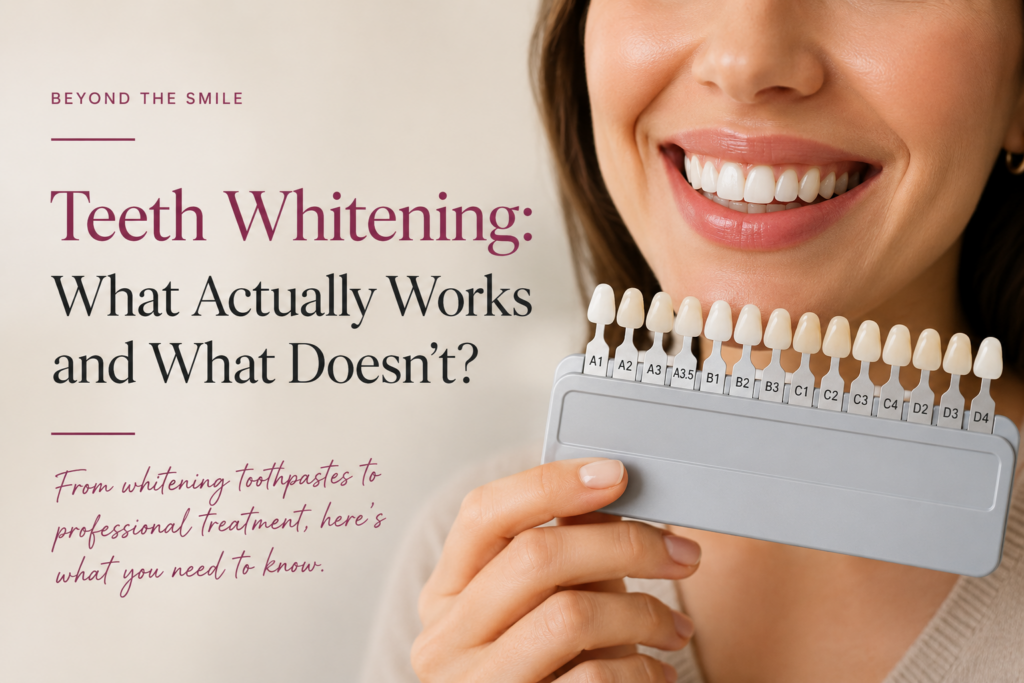
From whitening toothpastes and strips to professional treatment and the elusive “perfect” shade.
If there is one area of dentistry surrounded by clever marketing and quick fixes, it is probably teeth whitening.
Whitening toothpastes. Whitening strips. Charcoal powders. LED lights. Professional home whitening. In chair whitening. – They all promise a brighter smile, but they don’t all work in the same way.
And perhaps more importantly, “whitening” on the label doesn’t necessarily mean that a product is actually changing the colour of your teeth.
So, what really works?
What actually makes a tooth whiter?
There is an important difference between removing stains from the surface of a tooth and actually changing the colour of the tooth itself.
Tea, coffee, red wine and smoking can leave external stains. A professional clean or certain toothpastes can remove some of these, making teeth look brighter without changing their underlying colour.
True tooth whitening works differently. Whitening agents such as hydrogen peroxide or carbamide peroxide penetrate the tooth and break down coloured molecules within it, making the tooth itself appear lighter.
That distinction explains why products labelled “whitening” can produce very different results.
Do whitening toothpastes really whiten teeth?
This is one area where I am quite cautious.
Many whitening toothpastes work primarily by removing surface staining, often using abrasive particles. Their abrasiveness varies considerably, so this doesn’t mean that every whitening toothpaste is harmful.
But more abrasive isn’t necessarily better.
Frequent use of highly abrasive products, particularly alongside aggressive brushing or where there is already tooth wear, can contribute to loss of tooth structure.
There is an unfortunate irony here. Enamel is relatively translucent, while the dentine underneath is naturally more yellow. As tooth structure is worn away, more of this underlying colour can become visible. – So aggressively trying to scrub your teeth whiter can potentially have the opposite effect over time.
What about whitening strips and products bought online?
UK regulations make an important distinction here.
Products freely available directly to consumers can contain or release only very low concentrations of hydrogen peroxide. The concentrations used for effective professional tooth whitening are restricted to supply through dental professionals.
This is why many products you can simply pick up in a shop are primarily removing surface staining rather than bleaching the teeth in the same way as professionally supplied whitening gel.
I would also be cautious about stronger products bought from unknown sellers online. Whitening isn’t appropriate for every mouth, and knowing exactly what you are putting on your teeth matters.
Does whitening damage your teeth?
When appropriate products are used correctly following a dental assessment, tooth whitening is generally considered a safe and conservative cosmetic dental treatment.
The most common side effect is temporary sensitivity.
Some people experience sensitivity to cold or occasional short, sharp sensations while whitening. This usually settles when treatment is reduced or stopped and doesn’t automatically mean that the enamel is being damaged.
This is also one reason I like supervised home whitening. We can adjust the frequency or duration according to how your teeth respond.
Why I’m not a big fan of in chair whitening
In chair whitening sounds very appealing. You arrive with one shade of teeth and leave an hour or two later with noticeably brighter ones.
And it can whiten teeth.
But it isn’t usually my preferred approach.
Part of the dramatic immediate change following in chair whitening can be influenced by temporary dehydration of the teeth. Dehydrated teeth appear lighter, and as they rehydrate afterwards, some of that initial brightness can reduce.
Home whitening is also often recommended afterwards to develop or maintain the result.
For me, that takes away some of the appeal of trying to achieve everything in one appointment.
Why I prefer home whitening
With professionally supervised home whitening, custom made trays hold whitening gel against the teeth and the colour changes gradually.
It isn’t as dramatic on day one, but I actually see that as an advantage.
You can watch your smile become brighter, we can adapt treatment if you experience sensitivity and, perhaps most importantly: you decide when your teeth are white enough.
Some people want a noticeably brighter smile. Others simply want to take away a little of the yellowing that has developed over the years.
There isn’t one shade everyone needs to reach.
You simply stop when you look in the mirror and think: That’s enough. I like them like this.
For me, that feels much more natural than chasing the whitest shade possible.
What about fillings, bonding, crowns and veneers?
This is particularly important when planning cosmetic treatment.
Whitening only changes the colour of natural tooth structure.
Composite fillings, bonding, crowns and veneers don’t whiten with your teeth.
So if someone wants both whitening and composite bonding, I will usually whiten first, allow the colour to settle and then choose the composite shade to match.
Sometimes whitening first can even change how much treatment someone feels they need. A smile that initially seemed to need a significant cosmetic change can feel completely different once the teeth are simply brighter.
And what about charcoal and other DIY tricks?
I would be cautious.
Charcoal powders, bicarbonate mixtures and various social media whitening tricks may remove surface stain, but that isn’t the same as changing the colour of the tooth.
If something makes teeth appear brighter by aggressively abrading their surface, that doesn’t make it a good long term treatment.
When it comes to healthy enamel, I would much rather preserve it.
Sometimes the smallest change is enough
This is one of the reasons I like teeth whitening.
It can be one of the most conservative ways to change a smile.
We aren’t changing the shape of the teeth or removing healthy tooth structure. We are simply changing colour.
Sometimes whitening is the first step before composite bonding, veneers or another carefully planned treatment.
And sometimes it is the only step needed.
The goal isn’t necessarily to create the whitest smile possible.
It is to find the point where your smile still looks like yours, just a little brighter.