


Pain When Biting? Could It Be a Cracked Tooth?
Have you ever experienced a sudden, sharp pain when biting into something firm, only for it to disappear again almost immediately?
Perhaps it happens when you bite into bread with a crisp crust, chew something hard or release your bite after putting pressure on one particular tooth.
This type of discomfort can be difficult to explain and even harder to locate. One possible cause is a cracked tooth.
Cracked teeth are not always obvious. The tooth may look perfectly healthy, the pain may come and go, and the crack may not appear on an X ray. Finding the cause often requires careful examination, patience and sometimes more than one appointment.
One of my patients, Jenny, has kindly shared her own experience of living with cracked teeth and making decisions about treatment. You can watch Jenny’s story here.
What does a cracked tooth feel like?
The symptoms can vary depending on the location and depth of the crack.
Common signs include:
• A sharp pain when biting
• Pain when releasing your bite
• Sensitivity to cold drinks or food
• An occasional sharp sensation while chewing
• Discomfort that is difficult to pinpoint
• Symptoms that come and go
• A feeling that something is not quite right with one tooth
Some cracks cause no symptoms at all and are discovered during a routine examination. Others become increasingly uncomfortable over time.
Why do teeth crack?
Teeth are incredibly strong, but they are exposed to considerable pressure every day.
A crack may develop because of:
• A large existing filling that has weakened the remaining tooth
• Biting unexpectedly on something hard
• Clenching or grinding
• A deep bite or excessive pressure on certain teeth
• Repeated stress over many years
• Previous trauma
• Natural changes within the tooth as we get older
Teeth with large amalgam fillings are particularly vulnerable because there may be relatively little natural tooth structure remaining around the restoration.
In many cases, there is not one single dramatic event. The crack develops gradually until the tooth eventually begins to produce symptoms.
Why can a cracked tooth be difficult to diagnose?
A crack can be extremely fine. It may be hidden beneath an existing filling or extend through an area that cannot be seen directly.
Unlike decay or an infection around the root, a crack often does not appear clearly on an X ray. The pain can also be inconsistent. A tooth may feel uncomfortable one day and completely normal the next.
This means that identifying a cracked tooth sometimes takes time. I may need to assess the bite, test individual parts of the tooth, check its response to temperature and compare it with the surrounding teeth.
In some cases, an existing restoration needs to be removed before the location and extent of the crack can be properly assessed. Even then, it is not always possible to know exactly how deeply a crack extends.
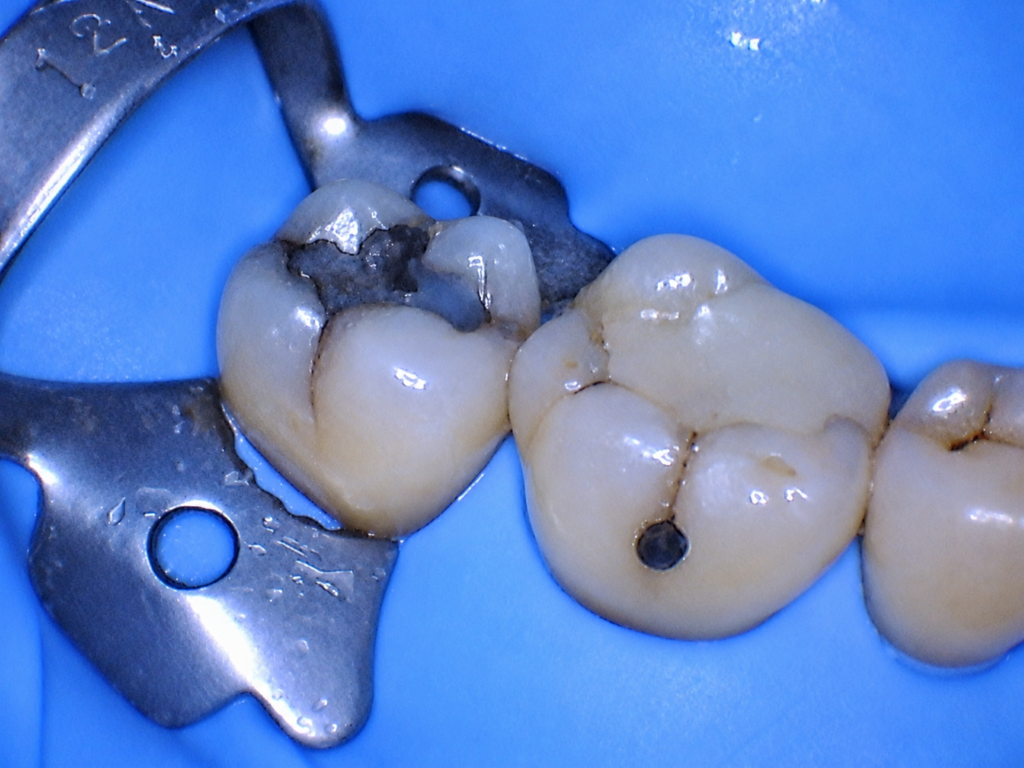
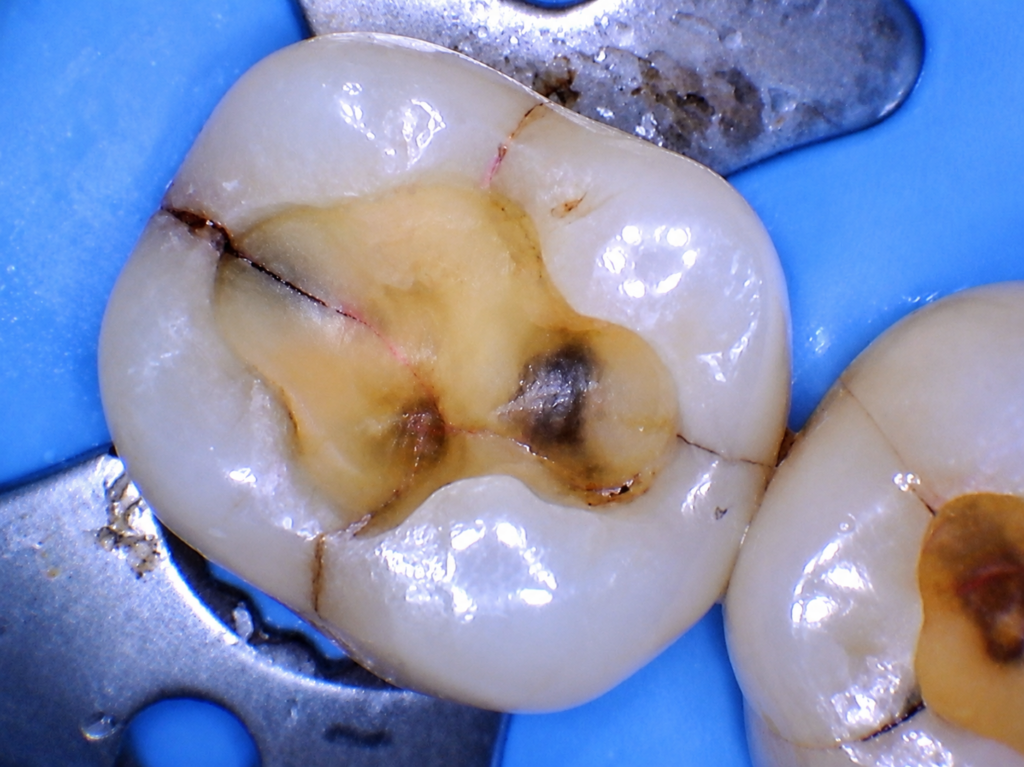
The tooth is isolated during treatment so it can be examined carefully in a clean and controlled field.
Once the existing restoration has been removed, crack lines within the tooth can become much easier to see.
These photographs show why a cracked tooth may look relatively unremarkable before treatment but reveal a very different picture once the old restoration has been removed.
Can a cracked tooth heal by itself?
A crack within a tooth cannot heal in the same way as a broken bone. However, not every visible crack needs immediate treatment.
If a crack has never caused symptoms and the patient has no previous history of cracked teeth, it may be reasonable to photograph and monitor it carefully.
My advice may be different for someone who has already experienced cracked teeth or lost a tooth because of a crack. This suggests that their teeth may be exposed to greater forces or that they are particularly vulnerable. In these cases, I am more likely to recommend protecting the tooth with an onlay or crown before symptoms develop.
Some patients still prefer to monitor the tooth. That is absolutely an option, provided they understand the possible risks and the available alternatives.
I ask patients to look out for any sudden sensitivity, a sharp sensation when chewing or pain when biting or releasing the bite. These changes may indicate that the crack has extended further into the tooth. If this happens, the tooth should be assessed again as soon as possible rather than waiting for the next routine examination.
Monitoring is therefore not the same as ignoring the crack. It is an informed decision that requires the patient to know what changes to watch for and when to return.
How is a cracked tooth treated?
Treatment depends on:
• Where the crack is located
• How deeply it appears to extend
• How much healthy tooth structure remains
• Whether the nerve is affected
• The symptoms the tooth is producing
• The amount of pressure placed on the tooth
There is no single treatment that is suitable for every cracked tooth.
Onlay or crown
If the crack affects one or more cusps but the tooth remains restorable, an onlay or crown may be recommended.
These restorations cover and protect the weakened parts of the tooth. Their purpose is to hold the tooth together and reduce movement when you bite.
An onlay can often preserve more natural tooth structure, while a crown may be more appropriate when the tooth is extensively weakened. The choice depends on the individual tooth rather than one option automatically being better than the other.
Root canal treatment
A cracked tooth does not automatically need root canal treatment.
Root canal treatment is considered when the nerve has become irreversibly inflamed or infected. Signs may include lingering sensitivity, spontaneous toothache, pain that wakes you at night or tenderness around the tooth.
If the nerve remains healthy, the tooth may be protected with an onlay or crown without root canal treatment.
Extraction
Unfortunately, some cracks extend too deeply for the tooth to be saved predictably.
If a crack travels far below the gumline, through the root or leaves too little healthy tooth structure, extraction may be the safest option.
Removing a tooth is never the first choice, but it is important to be realistic about prognosis. No dentist can guarantee the outcome of treating a cracked tooth because the full depth of the crack is not always visible.
What happens if a cracked tooth is left untreated?
Some cracks remain stable for years. Others gradually deepen as the tooth continues to flex under pressure.
A progressing crack can lead to:
• Increasing pain when chewing
• Inflammation of the nerve
• Infection
• A broken cusp
• Tooth fracture
• A tooth that can no longer be restored
Earlier assessment usually gives us more options, particularly when the nerve is still healthy and enough strong tooth structure remains.
Does grinding make cracked teeth worse?
Clenching and grinding can place considerable pressure on the back teeth. Many people are unaware that they do it, particularly during sleep.
I also assess how the teeth meet and whether a deep bite or uneven contact is directing excessive force onto one particular tooth.
When clenching or grinding appears to be contributing to the problem, a custom night guard may be recommended after the tooth has been treated. This does not remove the crack, but it may help protect the tooth and other restorations from further stress.
Can cracked teeth be prevented?
Not every crack can be prevented, but the risk can sometimes be reduced by:
• Avoiding chewing ice and very hard foods
• Not using your teeth to open packaging
• Having large or failing fillings reviewed
• Addressing clenching and grinding
• Wearing a night guard when advised
• Attending regular dental examinations
• Seeking advice when pain on biting begins
A brief, occasional symptom may seem easy to ignore. However, if the same tooth repeatedly hurts when you bite, it is worth having it assessed.
Concerned about a cracked tooth?
Pain when biting does not always mean that a tooth is cracked. It can also be caused by decay, an uneven bite, inflammation around the tooth or a problem with an existing restoration.
A careful assessment helps identify the most likely cause and allows us to discuss the appropriate options without rushing into treatment.
If you are experiencing pain when chewing or releasing your bite, you can arrange an assessment with me in Wimbledon or Twickenham.